

An American Adventure Story
How John B. Stetson built his namesake company. Excerpted from Stetson: American Icon, available now.
By Douglas Brinkley
For more than a century, Stetsons were made in Philadelphia by a man from New Jersey. In a sense, though, the company started far out West, at the time of the Civil War. John B. Stetson, born in 1830, was in poor physical condition as a young man, receiving a diagnosis of tuberculosis that would ultimately keep him from military service. In the late 1850s, he left his home in New Jersey, in favor of the dry air of the West, settling first in Missouri, where he learned to make bricks. It was a perfect match for a man with very little capital, but a true gift for manufacturing. The elements needed for bricks were free, or nearly so, in St. Joseph: clay, water, straw, sunlight, and wood for fuel. In the span of about eighteen months, Stetson moved from laborer to manager to part owner to sole owner of a brickyard on the banks of the Missouri River. In his company’s first season, it produced a whopping half-million bricks that were laid out along the riverbank to dry. Unfortunately, the entire inventory was washed away in a flood. Stetson lost money but not a bit of his ambition; in fact, the experience solidified his intention to own another business. First, though, he wanted to see more of the West, including the Rockies, and it was there that he recognized his true calling. The family legend was recounted by his son, John Jr., during a 1938 interview:
My father was very frail as a young man and went West to regain his health. He joined some other young men who were walking to Pikes Peak [in Colorado], amusing his friends by making a hat out of felt, using the fur of the rabbits, beavers, and skunks they killed along the trail.
The hat was big and picturesque. It protected him from the wind and rain, as well as from the scorching sun. Besides, it attracted attention. A bullwhacker on horseback, gaily seated on a silver-mounted saddle from Mexico, looked upon this hat with envious eyes, and then offered my father a five-dollar gold piece for it. This was the first genuine Stetson hat made and sold.

Stetson had learned to “build” hats — the verb that hatters prefer, rather than “make” — from his father, Stephen, an independent hatter of intermittent success in New Jersey. No doubt aided by the built-in help of his wife and twelve children, Stephen ultimately gained a good reputation and retired after amassing a fortune of $50,000 — which he almost immediately lost in bad investments. The family was in some disarray by the time John returned home during the last year of the Civil War, but he was in better health; and, equally important, he had firmly decided to seek his own fortune in the family trade. After an initial hat-making partnership failed in New Jersey, he borrowed sixty dollars from his sister, moved to Philadelphia, and started the John B. Stetson Company, at first merely cleaning and repairing hats.
Almost immediately, Stetson made his mark, perfecting his all-season western hat and introducing it as his first product: The Boss of the Plains. Aside from the originality of the design (which was inspired by that first hat he crafted in Pikes Peak), the new hat was revolutionary because it had a name — a flashy, romantic, storytelling identifier different from the categoric “Derby – formal no. 3,” for example, that other hatmakers used. This was a Stetson innovation: His hats would have an identity. They would be a brand.

“Almost immediately, Stetson made his mark, perfecting his all-season western hat and introducing it as his first product: The Boss of the Plains.”
As a design, the Boss was the very first cowboy hat. It had a generous crown and a four-inch brim, the latter being regarded by other hatters as a remarkable feat in shaping. The felt, derived from pulverized beaver fur, was effectively waterproof, holding its shape even after it was drenched. The Boss had antecedents, of course: The sombrero found in Mexico and South America was similar to Stetson’s Boss, as was the plantation hat used in the South.
During the Civil War, cavalry soldiers in the Union Army wore a wide-brimmed hat to protect their faces from branches while riding through foliage. One more precursor was the rawhide version made by cowboys. Out in open territory, a cowboy would dig a hole the size of his head and then methodically press wet rawhide into it, forming the crown and then shaping the brim on the level ground. When it was finished, he’d let it dry and then fix the shape by leaving it in a smoky enclosure.
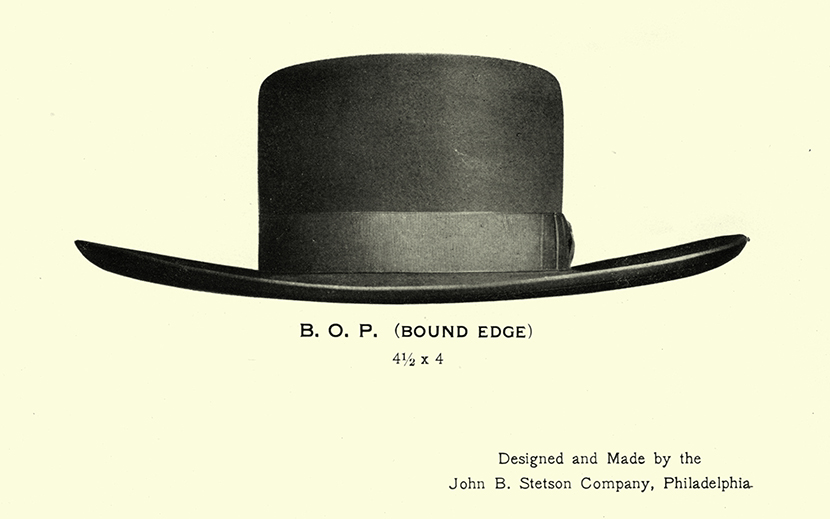
Stetson’s hat was more durable than its precursors, though, and more distinctive, starting with its outsize brim and ribbon-bound edge. Sometimes small innovations can change a familiar object entirely, and so John Stetson deserves credit as a designer. Purely practical throughout, the hat nonetheless had a bold stance and even in that early iteration, it complimented buckskin and dungarees. More styles would follow: bigger or more compact, rounder or squared off in the crown. The model evolved yet was still instantly recognizable as a Stetson. The name built a reputation with the passing years, in part because well-crafted felt lasts a long time, and Stetsons often ended up looking even better with age.


Stetson was creative in marketing his hat to retailers in the West: He would send samples to far-flung stores across the country, then have the home office press them relentlessly for orders. Once the outline of a retail network was thus created in a region, the Stetson Company built a sales force around it, pressing field salesmen hard to push the hats into stores — and, importantly, into local newspapers. They succeeded on both counts, and there was typically a small article in the paper whenever a shop began to carry the Stetson. Moreover, the word “celebrated” was almost invariably attached, as in “the celebrated Stetson hat.” The strategy worked, and by the mid-1880s, ads throughout the western states set the brand apart. Headlines like this one in a Billings, Montana, newspaper in 1885 proclaimed: “COWBOYS: This is your chance to get a square deal … Stetson hats and riding boots.” Other hats, if they were carried, were just hats. A Stetson was a Stetson.
All the ground-breaking marketing techniques in the world wouldn’t have meant anything if the Stetson Company hadn’t had equal partners in the effort: real cowboys. On the range in the 1870s and 1880s, a Stetson became more than a hat — it was a tool. Cowboys fanned campfires with them, swung them high to herd cattle or horses, carried water in them, used them as a cover for anything delicate or secret, and relied on the interior sweatband as a portable file cabinet. In addition, the hatband that encircled the crown could be detached when a cowboy needed something akin to rope. No other hat could do so many things so well. Cowboys also praised the Stetson as a hat big enough in every direction to cover the long hair most of them wore. They knew there was something special about a high-quality product made for a coarse way of life. Hats made so expertly of extra-fine materials had previously been aimed only at the carriage trade. They were handled with care throughout their lives, exposed to the weather only in the span between a gentleman’s closet at home and the cloakroom at his office — or the opera house. The Stetson offered the same standard of quality to cowboys whose hats had to be abused by the elements only because they were themselves being buffeted by the same rain, sleet, wind, and sweltering sun.


On the range in the 1870s and 1880s, a Stetson
became more than a hat — it was a tool.
The Boss of the Plains and its many descendants fueled tremendous prosperity at the Stetson Company, both in generating revenue and in lending distinction to the rest of the styles in the line. Derbies and similar “city” hats still made up the majority of sales, but not by much. In 1878, John B. Stetson announced: “We have never done a better business than we have this year. My own sales amount to twenty-five percent more than last year’s.” All of his annual reports were substantially the same as that one. By 1888, John Stetson was the sole owner of the largest hat manufacturing company in the world. The Stetson success story, however, wasn’t the fairly common one of driving down the price of a product through various shortcuts. Quite the opposite: Stetson hats were the pinnacle of quality.
If Stetsons were beautifully produced, the price reflected it. In the 1880s, the Stetson cowboy hat was typically priced in stores at five dollars — a week’s pay for most cowhands. But according to self-appointed judges in the trans-Mississippi West, it was perfectly all right to copy the cowboy persona. The crime was in getting it wrong. The consensus was that the prime insult to the real cowboy lay in getting a fake Stetson — saving a few dollars and then looking like “the rankest misrepresentation of the wild and wooly west” in Burke’s words. The core of the insult lay in the fact that millions of poorly compensated cowhands were willing to pay good money for the intrinsic quality of their Stetsons. Like a strain out of Owen Wister’s The Virginian, that sort of commitment was part of the culture out on the range. It followed that if you wanted to copy a cowboy, to make the grade, then you had to copy his values. That was the message on Western heritage delivered by the old-timers.


Aside from the bragging rights in owning a Stetson, practical customers knew that it would last decades, maybe even a lifetime. Women of the West, sharing the hard work of the ranching life, were often known to wear Stetsons too. In that vast, nonconformist region, even western women who didn’t live the outdoor life took to Stetsons from the very start; it was their statement too. (The same wasn’t true elsewhere; cowboy hats for women were unheard of in other regions until the 1930s and beyond.)
Hard as they tried, other hat manufacturers (including some of his own relatives, who took what they’d learned from John B. to start their own firms) couldn’t stop the Stetson juggernaut. This was in part because rather than chasing trends, Stetson himself doubled down on his commitment to quality of production by investing in a precious resource: his work force. Inspired in part by his strongly held religious beliefs, his solution to the labor movement that was taking down his competitors was to offer stability and opportunity to the more than three thousand workers in his vast Philadelphia factory. Stetson brought year-round employment to an industry known for its feast-and-famine ways; he also granted paid vacation time. For decades, he gave his employees bonuses and gifts at the company’s famously sumptuous Christmas celebrations. He provided medical care at no cost, building a hospital that was later expanded and opened to the public. He gave the workers a gymnasium and programs for sports, education, and an extensive Judeo-Christian Sunday School. Finally, John Stetson gave his employees one more thing: a piece of the company. In 1894, he issued stock, largely to ensure that his employees received shares. Because the company paid a reliable dividend, it was also a means of profit sharing. When John Stetson died of an apparent stroke in 1906, he left five million dollars, a fortune then (or now). It easily would have been at least five times that much, however, if he hadn’t already given so much directly to his workers; a long list of charities; and to universities, including Temple in Philadelphia and the former DeLand Academy in Florida, which was renamed Stetson University in 1889.
By the time Mr. Stetson died, however, his cowboy hats were positioned to live on without him. His Boss of the Plains and the millions of Stetson western hats that followed had already become a vivid part of American culture.
Excerpted from Stetson: American Icon (Rizzoli, 2025), available now.